
A special guest testimonial from Julie Easley
Who would have thought when I joined Tees Women Poets that I would end up at the United Nations, for the CESCR (Committee for the Economic, Social & Cultural Rights) 7th Review of the United Kingdom in Geneva, Switzerland?
It all started when Tees Women Poets partnered up with anti-poverty charity Thrive Teesside and gave me the opportunity to facilitate poetry workshops for a new poetry collective called Thriving Women. Writing around the lived experience of poverty and social exclusion, Thriving Women has given me a sense of purpose and planted the seeds for the dream I’ve had since a kid. To write.
It’s taken me decades to get to this point, from a tough childhood, through words that crushed any thoughts of a career as a writer (‘girls like you don’t write’), to Amanda White to Bob Beagrie to Andy Willoughby to Janet Philo to Kirsten Luckins to Tees Women Poets to me – a full-time poet. I have never been more content in my life as I am now; my workload is heavy but my diary is full and my heart is glowing with words and groups and poems.
My first foray into running workshops was scary, who do I think I am??? I was shy, full of doubt and well, we all know that imposter syndrome thing, don’t we? Now, I think I’m quite good at it, mainly because of the feelings it gives me, because of the joy I get from the poems written and because of the trust and relationships I make as a beautiful consequence.
When TWP teamed up with Thrive my world opened up. Finally I was able to create something from my own lived experience, my working-classness was a positive for once, my political venting didn’t cause eye-rolling and sighs. I was heard. If you relate to that, then you know how life-changing that is, and believe me, my life has changed.
Through Tees Women Poets my confidence as a person has soared, I can rock up to any stage anywhere, to any new writing group, and not feel that sense of intimidation or that I have a right to be there. Similarly, Thrive Teesside have supported and encouraged me and my trip to Geneva was at their invitation, in my role as Thriving Women workshop facilitator – I was there as an observer, a poet, someone with lived experience, and as a contributor of the GRIPP submission to the International Committee on Economic, Social & Cultural Rights, or ICESCR for short.
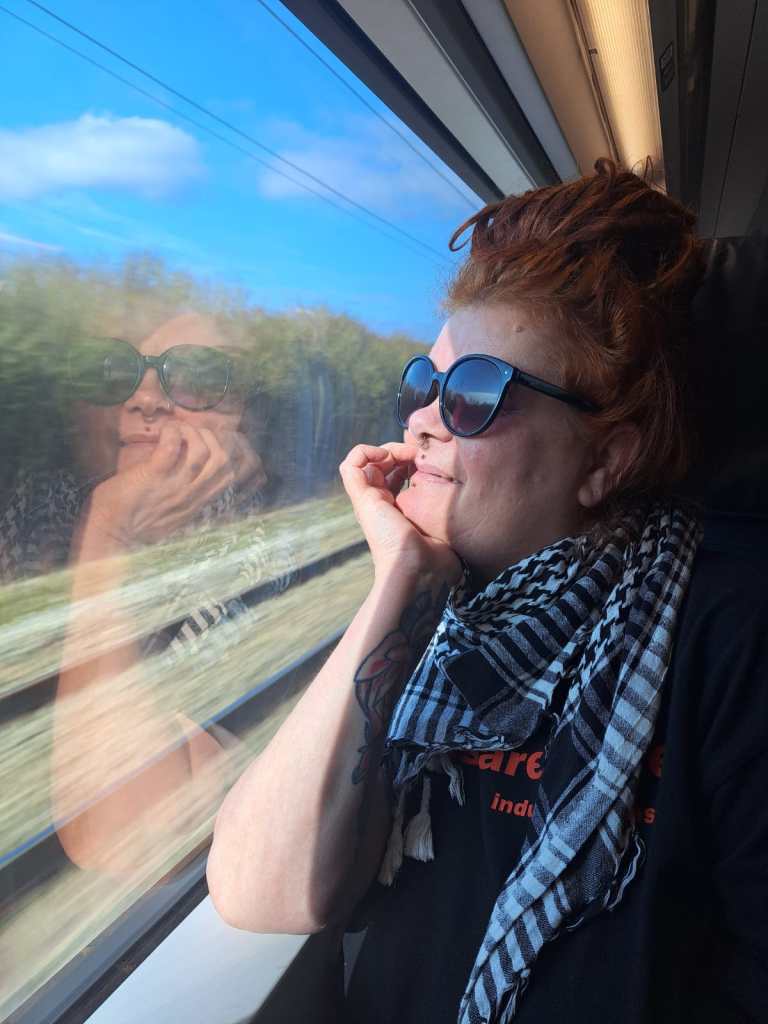
Ode to the French things seen on train journeys through France
(Teesside to Geneva)

Oh, dear French things in France
so magnificently magically French.
French windmills standing statuesque and serene,
arms reaching to the clouds, waiting
for the weather to turn their heads.
French sun drenching English faces
through windows of French trains, defying
the isolationist ideals of separation -
this French day will smile on all.
French fields crisscrossed with the neatest of bushes
binding the greenish lushness to the earth below.
French sheep munching French grass with French teeth.
French horses neighing in beautiful French accents.
French pigeons cooing and pooing in much more romantic tones.
Gawdy graffiti on whitewashed walls beneath high rises,
deprivation in French is still deprivation.
Outside stations, French ashtrays
masquerading as guards in dull metal jackets,
their studded shoulders decorated
with tab end medals.
Slippery shiny surfaces on French platforms,
stretching as far as the eye can see,
hiding unfindable lifts.
The sortie salida exit,
how dare the French declare how to get out in multiple languages,
how dare they etch French values onto buildings
like ink onto skin.
Liberté, égalité, fraternité,
it's as if equity was meant for us all,
if only we could live it.
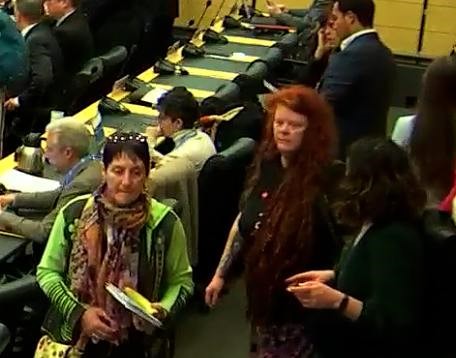
It began with a mammoth train journey from Teesside to London to Paris to Geneva and ended up with me sitting in a room in a United Nations building in Geneva – headphones on – listening to people in glass encased pods high above me translating the words of the representative of the UK government. The UK rep sat on the ‘big table,’ with the chair of the UN beside him along with other ‘big’ people from the UN. They were projected onto a cinema style screen with a massive digital countdown clock that flashed dangerously red when time was up.
Sitting directly, vertically, from the ‘big table’ were more UN committee members and UK government reps, including DWP, Home Office, Scottish, Welsh and NI reps, Justice and Housing. Beyond were ‘us,’ the civil society, I was sandwiched between Thrive Teesside and Amnesty International UK (Tracey & Laura) and surrounded by JustFair, Humans Right Watch, ATD Youth Voices, Friends, Families and Travellers, & RAPAR to name just a few. I felt strangely comforted, a poet among peers.
In many ways this was a first for me, in that someone like me was somewhere like that, but I was reassured when Tracey felt that too and kept reminding me – I had a right to be there, and although I felt out of place, I wasn’t intimidated by the formality or grandeur of it all, or even by security sniffing my little flask of earl grey tea!
There were 72 such submissions to the UN, (a record, I heard) and ours began life back in 2024, when Sarah (from Thriving Women) and I joined Tracey from Thrive to meet up with GRIPP (Growing Rights Instead of Poverty Partnership). We then wrote our section of the submission on Article 9 – the Right to Social Security – and included poetry from the Thriving Women, Mandy and Sue, (and Dylan from Thrive!) as well as lived experience testimonies and recommendations for the UK government to take into consideration.
The months of work (years from Thrive and others) were now being used by the UN, headed by a Special Rapporteur (surely a name for a new superheroine) to question the UK government on the impact of their policies on the Economic, Social & Cultural Rights of their citizens. These are your everyday human rights, rights that make life bearable – right to adequate standard of living, right to education, health, social security, family life, work & rights at work. Importantly, these are human rights which affect the most vulnerable in our country and were removed from the Equality Act 2010 by the previous government.
Now, there are many ways to avoid a question, and the UK delegations’ skill in question dodging was so good they should win awards for it. They used every way imaginable by replying with evasion, avoidance and blame – (at one point even blaming the translators ability to translate questions correctly!) A technique unfortunately parroted by politicians worldwide. A technique that allows them to spew out facts and figures and skirt around issues without actually saying anything. Same old, it’s sometimes referred to.
Blah Blah Blah

All talk
Mouths move
Repeat repeat repeat
Justify their unwillingness
to comply
with international law
using devolution
as an excuse
Quoting countries
not even mentioned
Nothing to see here
Nothing new heard
Same old
Same old
There was a lot of information, a lot of back and forth, a lot of the UK rep congratulating himself on his teams good timekeeping (the countdown clock), but very little to be excited about. I did learn a few things though:
“Nobody thought it was worth the effort”*

They want to build our financial resilience
with plans and reviews as if we don’t know
what resilience is.
They want 10 years to address child poverty.
They want to revel in their lovely slogan
‘stable homes built on love,’
but words are just words
and millions could be immediately saved by repealing
the 2-child benefit cap.

They want us to believe that forcing the disabled
and sick into work is the new definition of ‘inclusive.’
They want the poor to die 17 years before the rich,
and though they know child obesity is double in deprived areas
they can’t relate it to the impact of their policies
because they have millions for this and millions for that.
They want to rename sickness as health.
They want employment support to mean benefit compliance.

They want to brag about future plans and future reviews
but minimise implementation,
and even when they admit failing children in poverty,
because too many are taken away from families,
they dismiss discussions of change.

They want to erase children from gender health care
because trans kids don’t exist, right?
They want to invisiblise a whole community,
eliminate their rights, expunge them.
They want to reimagine it as women’s rights,
because disappearing children from vital support
somehow protects lasses from inequality,
when in reality it just kills trans kids and women
are still begging to be seen, because women
are still legislated with ‘some exceptions.’

They want increased powers for the police
as if the Police Act 2022 isn’t already overreaching,
as if it doesn’t directly discriminate the Traveller community,
as if violating their humans rights to adequate housing
isn’t criminalising a whole lifestyle.
Just for being.

They want to preach there is ‘strength in our diversity,’
yet continue to allow the exploitation of migrants
by denying them the right to work.
They want private landlords to remain as immigration
enforcers, meaning a home can quickly become a prison.

They say being a country of devolved nations,
without a constitution,
means the UN doesn’t understand
how difficult it is to implement this covenant.
They don’t say
that without this covenant
being implemented into domestic law
means that human rights can't be enforced,
and there’d be no access to legal representation.

They say “Nobody thought it was worth the effort”*

*(quote from the UK state representative at the UN ICESCR 13/02/25)
It was an intense 3 hours followed by our closed meeting with several of the UN committee members chaired by Human Rights Watch and facilitated by Jess from JustFair. This was the first time the UN had heard directly from lived experience, the first time a poem had been read out (by me) and we had 3 minutes each to put forward our concerns. It was very emotional to hear the lived reality of government policies on the most vulnerable in our country. Refugees and the right to work, kids in the social services system and the right to family life, the Roma/traveller community and the right to housing, and our GRIPP speeches, Amanda for ATD and the right to family life, me for Thrive and the right to social security and Tracey for RAPAR, on behalf of Almamy, on the right to work. The UN listened, commented and treat us with respect, they did mention, however, that we had all heard the UK’s response to their questioning.
Did we change things? I don’t know. Will we make a difference? I’m not sure. Will the UN take our lived experience into account when they make their response to the UK? Yes I think they might. Will the UK make any changes to their policies following UN recommendations which is the next stage we await? Well that remains to be seen, I don’t have any expectations about that, this is the same government who has chosen to continue austerity. Was it worth it? Absolutely and I’ll tell you why.
I met loads of people with a million names thrown at me at every corner, and was saturated with quotes and numbers and trying to read maps, but that hour and a bit with the UN committee and our speeches proved one thing to me. We have to break through the ‘othering’ that goes on in the UK. We have to remind each other at every opportunity how much we share, how much we can achieve if we work together. All of us in that closed meeting, laying ourselves bare to strangers, not only have to fight a system that denies our basic everyday human rights but also a culture that pits us against each other. The migrant who is stealing your job or your house, the traveller who dares to ask for decent housing, disabled people who fake disability, the trans community who want to erase women and the low paid workers who scrounge benefits. In that room, in that instance, we were one voice united in our solidarity, our lived experiences intersected and connected, and the blame, not directed at each other, but at the government policies that keep us divided, demeaned and devalued.

I have a new understanding of Thrive, even more respect for what they do. They are a team of just 3, Tracey, Coy and Dylan, operating from a small office in a community centre in Norton. Every 2 weeks they welcome us, the Thriving Women, giving us a safe and supportive space to write about issues we shouldn’t have to write about. More than that they have allowed us to grow and offered opportunities to take the Thriving Women poetry to national and international audiences, from church action groups, poverty truth commissions, parliament, and now all the way to the United Nations. They have also included us in creative sessions where we have learnt book binding and screen printing and visits to York, Leeds and London to connect with other organisations around lived experience. Their trust in taking me to the United Nations to speak on their behalf is something I will treasure.
The partnership with TWP and Thrive Teesside has become something I cherish, and the Thriving Women continue to challenge and amaze me. Through them, I have become a better workshop planner and we have explored everything from sestina’s to litany’s to dancing in the street like Kingsley from Benefits. We have made films, published books and laughed and cried and everything in between. Their poetry, I’m sure they won’t mind me saying, is tighter, fightier, and blows my mind week on week.
None of this would have happened without Tees Women Poets, without Kirsten’s belief in me and that, in return, gave me the permission I needed to push myself, to apply for things I was scared of, to say, quietly, yeah I think I can do that.
 Tees Women Poets